Revenue-Based Financing

Financing Your Growth-Stage Company: Choosing Between Equity & Debt

Growth-stage companies face a financing question that has only become more nuanced over the past several years: should you raise equity, take on debt, or combine the two?

What has changed since this question was first asked is the market around it:

Venture debt has grown from a niche product into a meaningful part of the capital stack. The U.S. venture debt market reached an estimated $53.3 billion in deal volume in 2024, nearly double the prior year, according to PitchBook.

Meanwhile, late-stage tech valuations remain roughly 40% below their 2021 peaks, making equity more expensive in dilution terms than it was during the last boom.

What Is Equity Financing?

Equity financing involves raising capital by selling a percentage of ownership in your company. Investors, typically venture capital firms, growth equity funds, or angel investors, provide capital in exchange for shares. Their returns come from a future liquidity event: an acquisition, IPO, or secondary sale.

For growth-stage companies, equity investors typically look for established markets, proven unit economics, and a repeatable customer acquisition process where lifetime value exceeds the cost of acquisition. The company may or may not be profitable, but it should demonstrate a credible path to profitable growth.

What does equity dilution actually look like?

According to Carta's State of Private Markets data, median dilution in 2025 sits at approximately 19.5% for seed rounds and 18% for Series A rounds. Series A investors generally look for 1530% ownership. These figures are actually higher than the peak of 2021, reflecting a market where capital has become more expensive and investors are demanding more ownership for the risk they take on.

After stacking dilution from a seed round, a Series A, and an employee option pool, founders (along with early angels and pre-seed investors) typically hold around 50% of the company post-Series A. By Series C, that number can drop considerably further.

Advantages of equity financing

  • No repayment obligation. Unlike debt, equity investors are not repaid in cash by the company. If the company fails, there is no outstanding loan to repay. This can provide peace of mind for early-stage companies with unpredictable cash flows.
  • Cash flow preservation. Because there are no monthly payments, the full investment amount is available to fund operations and growth. For companies burning cash to capture market share, this flexibility matters.
  • Strategic value beyond capital. Experienced investors can bring industry expertise, introductions, and governance discipline. Not every investor delivers on this promise, but the right VC partner can meaningfully accelerate a company's trajectory.

Disadvantages of equity financing

  • Highest cost of capital. If your company is successful, equity is by far the most expensive form of financing. The shares you sell at your Series A could eventually be worth multiples of what you received.
  • Loss of control. Equity investors receive board seats, voting rights, and governance provisions. These are designed to protect their investment, but they can constrain a founder's ability to make independent decisions about the company's direction.
  • Slow and expensive to close. Equity rounds involve complex legal documentation: certificates of incorporation, shareholder agreements, voting agreements, and more. Legal costs are significant, and rounds can take three to six months to close.
  • Forced liquidity timelines. The venture capital model is built on liquidity events. Investors need returns within a fund's lifecycle, which means founders may face pressure to sell or go public on a timeline that does not align with what is best for the business.

What Is Debt Financing?

Debt financing involves borrowing capital that the company repays over time, typically with interest. The lender does not take an ownership stake. Instead, they earn a return through interest payments and, in some cases, modest warrant coverage.

For growth-stage companies, debt financing can take several forms: traditional bank loans, venture debt, or revenue-based financing. Each has different requirements, structures, and trade-offs.

Advantages of debt financing

  • No equity dilution (or minimal dilution). The core appeal of debt is that founders retain ownership and control. With venture debt, any dilution from warrants typically works out to 1-3% of fully diluted equity, a fraction of what an equity round would cost.
  • Predictable cost. Interest rates, repayment schedules, and terms are agreed upfront. This makes it easier to model the true cost of capital and plan around it.
  • Founder retains control. Debt does not come with board seats or voting rights. When the loan is repaid, the relationship ends. There is no permanent claim on the company's upside.
  • Faster to close. Debt transactions are simpler from a legal and due diligence perspective. A venture debt facility can close in as little as four to six weeks, compared to months for an equity round.

Disadvantages of debt financing

  • Cash flow impact. Monthly interest payments (and eventually principal repayment) create a recurring obligation. If growth stalls, these payments still come due. Companies considering debt need confidence in their ability to service it.
  • Collateral requirements. Some debt structures require collateral or security interests. This varies by lender and deal structure, but it is worth understanding what assets are being pledged.
  • Not suited for every stage. Companies with no revenue, no path to sustainability, or extreme cash burn are generally not good candidates for debt. Debt works best when there is a clear plan for how the capital generates a return.

Venture Debt

Venture debt has moved from the margins to the mainstream. The global venture debt market reached roughly $49 billion in 2025, and Deloitte projects the asset class could grow to represent 20% of total venture funding by 2027. The collapse of Silicon Valley Bank in 2023 initially disrupted the market, but it also opened the door for specialized private lenders and alternative debt providers to fill the gap.

Venture debt is a form of term debt designed specifically for growth-stage companies. It is typically structured as a senior secured loan with interest-only payments and a small tranche of warrants. Unlike traditional bank lending, it does not require hard assets as collateral, personal guarantees, or the strict covenant packages that banks impose.

When does venture debt make sense?

Venture debt works best in specific situations. It is not a replacement for equity, and it is not a lifeline for struggling companies. It is a tool for healthy, growing businesses that want to optimize their capital structure.

  • Extending runway to a milestone. If your company is 6–12 months from profitability or a significant valuation milestone, venture debt can provide the capital to get there without diluting right before the inflection point.
  • Complementing an equity round. Many companies raise venture debt alongside or shortly after an equity round to extend their runway and reduce the total amount of equity they need to raise. This is a standard practice that reduces the blended cost of capital.
  • Bridging between rounds. When equity markets are slow or the timing is not right for a priced round, venture debt can bridge the gap and keep momentum going.
  • Preserving ownership. For founders who are philosophically opposed to heavy dilution, or who are near a point where further equity raises would reduce their ownership below a comfortable threshold, venture debt offers growth capital without governance changes.

The math in practice: A company raising $12 million for growth might take $10 million in equity at a $50 million valuation (giving up 20%) and layer in $2 million of venture debt. The alternative, raising the full $12 million in equity, would cost an additional 4% dilution. Over time, that 4% can represent millions of dollars in founder value.

What venture debt lenders look for

Venture debt lenders have become more selective, particularly since 2023. In today's market, lenders generally look for revenue of at least $2-3 million (often more), a clear use of funds tied to growth, a credible path to the next milestone (whether that is profitability, a follow-on round, or an exit), and a management team that communicates clearly and manages cash thoughtfully. Pre-revenue companies or those treating debt as a last resort are typically not good candidates.

Learn more: 6 Growth Metrics Investors Care About Most
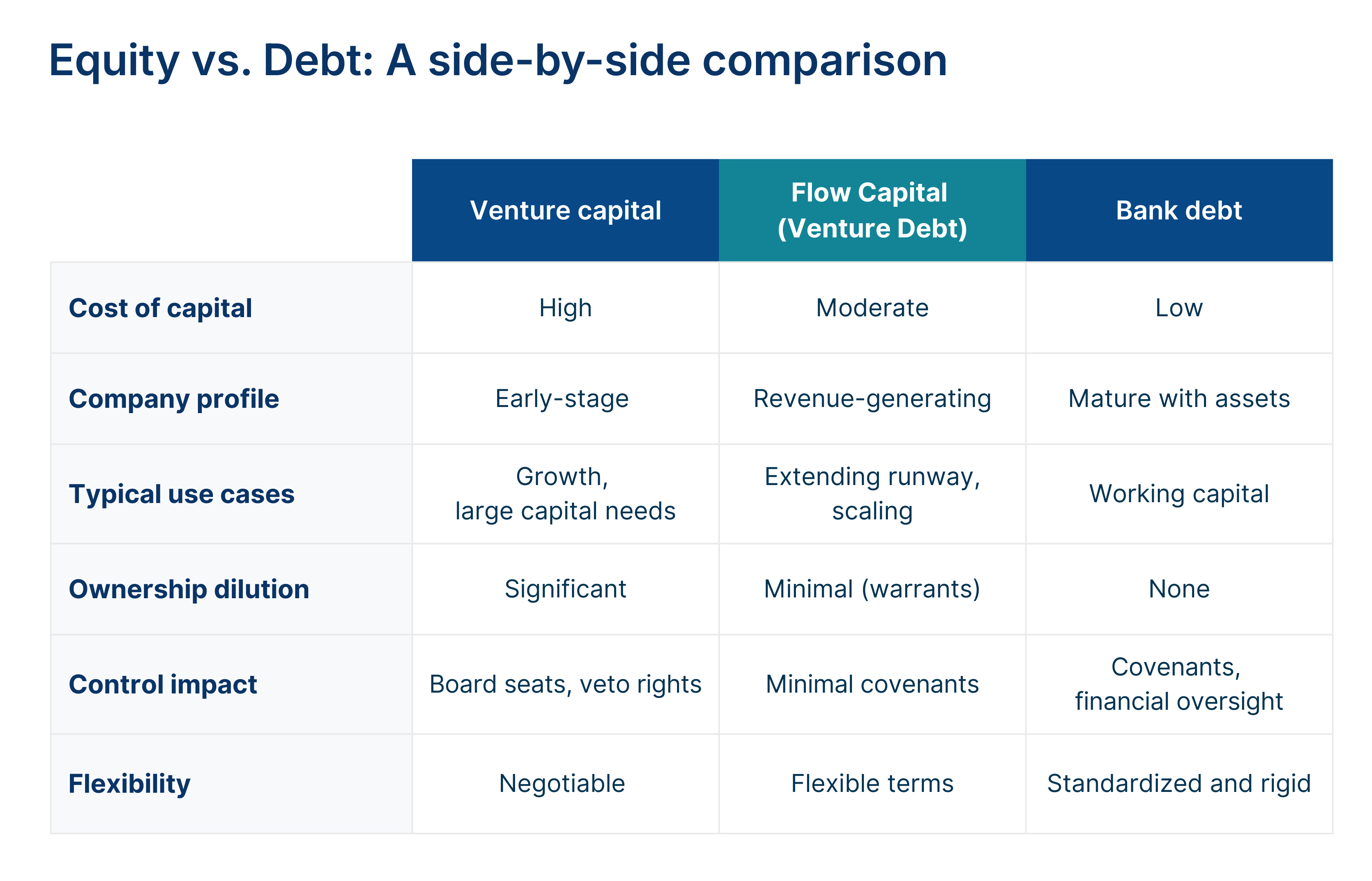
Equity vs. Debt: A Side-by-Side Comparison

Equity vs. Debt: A side-by-side comparison

How to Decide: A Practical Framework

The right financing structure depends on where your company sits today and where it needs to be in 12–24 months. Here are the key questions to work through:

  • What is your revenue trajectory? Companies with predictable, growing revenue are strong candidates for debt. Companies that are pre-revenue or early in their commercialization journey will likely need equity.
  • How close are you to a major milestone? If you are 6–18 months from profitability, a key product launch, or a valuation inflection point, venture debt can help you get there without diluting at a sub-optimal time.
  • How much ownership are you willing to give up? Model the cumulative dilution across your next two to three financing events. If the math shows you dropping below a level of ownership that keeps you motivated and in control, consider blending debt into your capital stack.
  • Can you service debt payments? Be honest about your cash flow. Venture debt with interest-only payments during the term is more manageable than traditional amortizing debt, but there is still a real obligation. Model the payments against your forecast and stress-test it.
  • What does your existing cap table look like? If you have already raised multiple equity rounds, the marginal cost of another one may be very high. Debt may offer a better cost of capital for incremental funding needs.

The blended approach: Smart CFOs do not think in terms of "debt or equity." They think in terms of blended cost of capital. Even when equity is available, the all-in cost of debt is often dramatically lower, particularly for companies with strong revenue growth. The most capital-efficient growth-stage companies use both strategically.

The Market Context in 2025-2026

Several trends are shaping how growth-stage companies approach financing today.

  • Equity remains expensive. While valuations have recovered from their 2023 lows, median Series A pre-money valuations reached $49.3 million in Q3 2025, according to Carta, deal volume is down and investors are more selective. Fewer rounds are getting done, and the companies that do raise are giving up more ownership than they were in 2021.
  • Venture debt is growing and diversifying. The post-SVB landscape has brought new lenders into the market, including private credit funds, specialized debt funds, and alternative lenders. This competition has generally been good for borrowers, with more flexible terms and structures available.
  • Down rounds remain a reality. Roughly 17% of all venture rounds in Q3 2025 were down rounds. For companies facing this prospect, venture debt can provide runway to grow into a higher valuation before raising equity.
  • Capital concentration is increasing. In Q3 2025, mega-rounds of $500 million or more captured over 30% of all venture funding, driven largely by AI companies. For growth-stage companies outside the AI hype cycle, accessing equity capital has become more competitive.
  • Hybrid structures are becoming more common. Companies are increasingly blending venture debt with equity rounds, revenue-based financing, or convertible instruments to build capital stacks that balance cost, control, and flexibility.


Founder's FAQs

What is the difference between equity financing and debt financing?

Equity financing involves selling ownership shares in your company in exchange for capital. Debt financing involves borrowing capital that you repay over time with interest, without giving up ownership. Equity is more expensive long-term but has no repayment obligation. Debt preserves ownership but requires cash flow to service payments.

What is venture debt, and how is it different from a bank loan?

Venture debt is a form of term debt designed for growth-stage companies. Unlike bank loans, venture debt typically does not require hard asset collateral, personal guarantees, or the strict covenant packages that banks impose. It is structured to work with the cash flow profiles of high-growth companies that may not yet be profitable.

How much equity dilution should I expect in a funding round?

In 2025, median dilution is approximately 19.5% for seed rounds and 18% for Series A rounds, according to Carta. By the time a company has raised through Series A with an option pool, founders and early stakeholders typically retain around 50% ownership. Dilution compounds with each subsequent round. For a deeper look, see our Founder's Guide to Equity Dilution.

When is venture debt the right choice?

Venture debt is typically a good fit when a company has proven revenue (generally $2–3M+), a clear growth plan, and the ability to service interest payments. It is especially useful for extending runway between equity rounds, bridging to a profitability milestone, or reducing the amount of equity needed in a financing.

See Is Venture Debt a Smart Move for Your Company? for a more detailed assessment.

Can I raise venture debt without being VC-backed?

Yes. While many venture debt providers require VC backing, some lenders, including Flow Capital, provide venture debt to both VC-backed and non-VC-backed companies. The key criteria are revenue traction, growth potential, and a sound business model.

How much does venture debt dilute my company?

Venture debt typically involves warrant coverage that results in 1–3% dilution of fully diluted equity. This is a fraction of the 15-30% dilution common in equity rounds.

Learn more
View all
Unlock growth with Flow Capital
Explore our funding options and apply for capital today